By: Camryn Rogers, EPS C82, Fall 2019
When thinking about waste in the ocean, the minds of many may immediately think about infamous videos such as the turtle with a straw stuck in its nose or fish choking on plastic pack rings. These two disturbing images are among hundreds of thousands of similar incidences that happen every single year but after delving deeper into the issue one has to ask: where does the rest of it go? What happens to garbage that is just left to simply float in the open ocean?
Let’s get sciencey. Specifically, about currents and how they created the Great Pacific Garbage Patch!
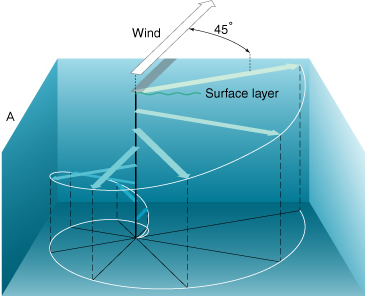
Before we get started, let’s cover some basics. One necessary concept to understand first is the Coriolis Effect which says that due to Earth’s rotation, winds and objects on the planet’s surface (most notably seen on the ocean’s surface) will deflect from their initial path. In the Northern Hemisphere, deflection is always to the right due to Earth’s counterclockwise rotation; in the Southern Hemisphere deflection is always to the left. This then ties into the workings of Ekman Transport whose source of motion comes from winds which influence wave movement. Because of the Coriolis Effect though, wave movement is always pushed from it’s original direction, resulting in an Ekman spiral. For example, if water is being pushed 90° North in the Northern Hemisphere, Coriolis will shift the water in a clockwise motion until its direction begins to shift more to the right eventually creating spiral movement.
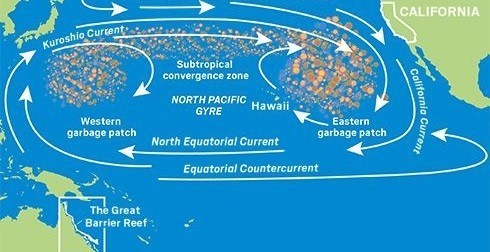
Now that we have our background information, let’s move onto currents! Currents are all over the world and are part of many important systems such as thermohaline circulation which allows for proper temperature control of the planet. Currents move with respect to the continents, forming the five main gyres: North Pacific Gyre, South Pacific Gyre, North Atlantic Gyre, South Atlantic Gyre, and Indian Ocean Gyre. A gyre is a large area whose water movement is created by the circulation of ocean currents. Now for the Great Pacific Garbage Patch, the key gyre involved is the North Pacific Garbage Patch and it’s notable currents: the California Current, North Equatorial Current, Kuroshio Current, and the North Pacific Drift. These four currents play major roles in transporting garbage from coast to coast until it all collects within the North Pacific Gyre in two ginormous groupings spread out over the width of the Pacific Ocean but are three times bigger than the entirety of France!

So now, how did this garbage patch come to be? Simple: ocean currents. Let’s look at a plastic bottle for our example. If there is a plastic bottle thrown off the West Coast of the United States, it will follow the California Current South past the coast of Mexico until both the Coriolis Effect and Ekman Transport work their ocean magic and direct the current to the right toward the open ocean. This plastic bottle will then float along the North Equatorial Current until it is caught up by smaller waves and trapped in either the Eastern Patch (closer to North America) or continues on until it reaches the Western Patch (closer to Asia). If this plastic bottle somehow misses the first turn off, it will continue until it is caught up in the Kuroshio Current along Japan where it most likely will then turn off into the other patch. If this plastic bottle somehow misses this one as well it will join the North Pacific Drift, the connecting current between the two patches which is littered with millions upon millions of discarded waste. The scariest part too is that this is not just an anomaly caused by mass waste by North America and Western Asian countries. There are major garbage patches in all five gyres which have collected trash from all surrounding countries.
This is why we must all be mindful of our plastic waste by thinking of where it ends up: killing marine life already at risk of over-fishing and other dangers such as oil spills (and other harmful chemicals), ocean acidification, and rising ocean climate. The last thing our beautiful marine life need to worry about is our mindless waste.
 Oceans in Motion