How recycling could save millions

Recycling. The term which hung itself up in the hallways of my elementary school and labeled the black, blue, and green bins in our classrooms. The term which floated through the air in high school and called on us to make a change. The idea which now seemed less optional and more like a plea for help. As I’ve gotten older, the call to action on recycling old materials and reusing ones we already had gained more traction as the reality of climate change became more apparent. It was the theory everyone was trying so desperately to implement into our day to day lives but always fell short either because of the economic implications, because of the lack of resources, or simply because people were not trying hard enough. But now, recycling is more important than ever and though some still seem to challenge its place in society it is impossible to doubt how crucial the process is. Especially when we look at the environmental impacts.

Now I have already done a post on packaging and how it has lead to the Great Pacific Garbage Patch so I won’t repeat myself but instead I think it’s important to understand how poisoning the ocean poisons humans in return.

Let’s assume for this post that our subject in question is doing their civic duty and using the recycling cans in and around their city and they have chosen to throw a plastic bottle into the recycling bin. Plastic bottles, as well as almost all other forms of plastic, are made of polymers which are a synthetic material which cannot be broken down by processing plants and is not biodegradeable. When a polymer enters the recycling process, it is basically just pushed aside and will instead end up in a landfill along with all other garbage that people get rid of. Once it enters a landfill though, it will just sit there for hundreds, even thousands of years, until nature is able to finally break it down but even then the plastic does not revert back into its initial elements and become one with the Earth again, oh no. This is where the real issue starts. It breaks down into microplastics.

Now, say this plastic bottle is washed away from the landfill into a stream that leads out to the ocean. In the ocean, the plastic bottle will follow that same process of breaking down into microplastics but instead of just melting down into the planet and staying there for those thousands of years, it will most likely enter the digestive tract of some sort of marine life. Let’s just say it is consumed by a tuna fish. When this tuna fish is then caught in a typical fishing process (which also leads to a lot of waste found in the ocean and detrimentally affecting marine life), these little plastic particles are still in its body. That tuna fish is then cleaned and sent to a store where someone buys that fish to eat. Whether that fish is fresh, cut into filets, or canned, there are pieces of microplastics in its system that we will inevitably eat. This issue has become such a large problem that is it estimated that every single person on the planet has microplastics in their bodies. Research conducted recently has began finding microplastics in human feces, meaning the issue is deep in our digestive tracts and shows no signs of letting up.

To begin recycling and reusing our products is to start saving ourselves from our own downfall and in return also begin saving the marine life community from our waste. Plastic is purported to outweigh fish in the ocean by 2050. By rethinking polymers and how it is we can recycle our waste, we can have a big impact on keeping out planet and its animals safe and healthy.
Earthquakes and Tsunamis: what makes them so dangerous?

Earthquakes are scary, that is not new information but it always seems to escape the public’s mind how dangerous they are until another one happens. Take a look at the earthquake that shook the city if San Francisco in 1989. A magnitude 6.9 earthquake erupted in the Bay Area at 5:04pm on October 17th and lasted for only 15 seconds but took the lives of 67 people in that time frame, the majority of which were crushed under the collapse of the top level of the San Francisco-Oakland Bay Bridge onto the lower deck. Over 3000 were injured during this time and many buildings and infrastructure collapsed under the quake’s violent shaking, especially San Francisco’s Marina district which was leveled during the chaos. This 15 second event cost the city over $5 billion in damages.

The 2011 Tohoku earthquake in Japan shows just how horrific an earthquake can become with a high magnitude and a reactive subduction zone. It became the most powerful earthquake ever in Japan and fourth largest since 1900. On March 11 at 2:46 pm local time, a 9.1 magnitude earthquake decimated many cities (especially coastal) in Japan, lasting for 6 minutes and destroying everything in it’s rocking. It’s reported than the earthquake was so powerful that it shifted the entire main island of Japan, Honshu, 2.4 meters east. over 120,000 buildings fully collapsed with 280,000 partially collapsed and another 699,000 partially damaged. The following tsunami also resulted in millions being left without power, water, food, or shelter. It even caused a nuclear disaster at the Fukushima Daiichi Nuclear Power Plant, causing one of the reactors to explode and spew out radiation to the surrounding area. The World Bank estimated the cost of the damage to be up to $235 billion, making it the most expensive natural disaster ever, 47 times more expensive than the 1989 San Francisco earthquake. The number of casualties officially recorded was 15,898 but with the inclusion of earthquake related deaths that number shoots up to 19,575!

So, what’s the cause behind the horror? What makes these earthquakes so dangerous? It’s all boils down to plate tectonics and waves; specifically body and surface waves. But let’s start with earth’s crust.

Earth’s crust is comprised of tectonic plates, a.k.a. what the continents sit on and what is below the ocean. There are two kinds of plates for each of these scenarios as well: continental plates and oceanic plates, both of which are made of the lithosphere and can shift in accordance with other plates. When plates do move in relation to each other though they do so at three different types of plate boundaries. The first plate boundary is a divergent plate boundary which is where two plates will move away from each other, forming rift valleys and mid oceanic ridges. The second type of plate boundary is known as a transform plate boundary, where two plates will slide against each other without actually moving away or closer to each other, causing faults. This kind of boundary can be found here in the Bay Area with the Hayward Fault. But the third type of plate boundary is generally the cause for many of Earth’s strongest, most relentless earthquakes. Convergent plate boundaries. At these boundaries, one plate will slide under another plate, causing the area of sliding to be called a subduction zone. These can cause trenches, volcanic mountains and islands, and mountain ranges and are the only boundaries that tsunamis can occur at.

Now, although earthquakes can happen at all three plate boundaries, there are different kinds of waves that can happen as a result of these earthquakes and these will determine the damage done to a location. When an earthquake first hits, it is P and S waves that will initially attack. P waves are the fastest and will arrive first. Known as compressional waves, P waves can move through all layers of the Earth from the mantle down to the liquid outer core and even further into the solid inner core. As is in their name, P waves force all materials in their way to contract and release while staying level relative to the land. S, or Shear, waves follow P waves and the second wave of attack in an earthquake. Since S waves are slower than P waves though, they can only penetrate the mantle of the Earth, unable to move through the liquid outer core or solid inner core. They also move differently than P waves. Where a P wave moves horizontally through compressions, an S wave will move in actual vertical waves. The third type of wave though is the most dangerous kind. Surface waves arrive last but cause the most damage during an earthquake, moving in a rolling motion like a wheel on a car. As the earthquake moves deeper though, surface waves become less of an issue.

As a study in plate tectonics, let’s look at the 2004 Indian Ocean earthquake and tsunami which was felt in Indonesia (which suffered the greatest destruction), Bangladesh, India, Malaysia, Myanmar, Thailand, Sri Lanka, and the Maldives and registered a magnitude of 9.1-9.3.

First, the earthquake which took place on December 26th. It is estimated that a 1600 km long fault line ruptured along the subduction zone of the Burma Plate and Indian, the later of which subducted under the other. The plate movement caused the longest ever recorded response of 8 to 10 minutes of shaking felt above ground. So, when the P waves first hit it was violent and sudden but the resulting S waves continued to hit Indonesia and surrounding countries following as well. When the surface waves occurred last though they obliterated entire cities and villages mainly in Indonesia but also in other Southeast Asian countries. The large displacement of the ocean from the subduction of the Indian Plate under the Burma Plate is what resulted in the tsunami moving out and toward the coastlines of Indonesia and surrounding Indian Ocean countries with waves reaching high points of 51 m!

This earthquake became the third most powerful one ever, one placement higher than Japan, but also gave the worst recorded tsunami in history. The total death count from this incident is thought to be as high as 227,898 with the majority being Indonesian but fatalities as far away as Kenya, Yemen, and South Africa. The economic cost was $15 billion which, although lower on the spectrum, fails to highlight the horrors experienced by all and the years of rebuilding that could never replace what was taken from the hundreds of thousands misplaced.

The Blackfish Problem

When the documentary Blackfish came out in 2013 it hit the world by storm. Tilikum, “Tilly”, the killer whale of interest at SeaWorld, soon became a household name but for all the wrong reasons, namely for the fact that he was tied to three fatalities and could be attributed to the closing of an marine life enclosure. The film explored the relationship between killer whales in captivity and humans is highlighted and explored throughout the film, opening conversation to begin taking over how it is that we perceive animals lives to be lesser than ours and how that has lead to horrific accidents attributed to this beautiful, dangerous wildlife. Blackfish forces our eyes open to the unethical treatment of not only killer whales but all animals we decide to hold captive. Because it’s never just the animals we capture that are impacted. We must start thinking of the physical changes they go through due to capture, their relations with other captured animals, and how our patterns of selection are taking away from necessary ecosystems.

When Tilly was first captured in 1983, it was off the coast of Iceland. This event alone can be looked down upon simply for its procedure and lack of empathy. Tilly and two others were captured at the time in a purse-seine net-a vertically long net weighed down at the bottom and kept afloat on the top by buoys-and then separated, leaving Tilly to begin his decade long process of transferring between facilities. This is where Blackfish director Gabriela Cowperthwaite argues his aggression began.

After spending a year post-capture at the Hafnarfjördur Marine Zoo in Reykjavik, Iceland, Tilly was transferred to Sealand of the Pacific, located on Vancouver Island, Canada at a small city named Victoria. He was there for eight years constantly subjected to ill behavior by two older female killer whales (Haida II and Nootka IV) within the same enclosure. Being out of his natural habitat and under constant stress from these two orcas, Cowperthwaite pinpoints this as being where violent attitudes in killer whales can be traced back to. It is unsurprising then that under constant animal-to-animal aggression the violence escalated until the first fatality occurred in February of 1991. 21-year-old marine biology student Keltie Byrne had fallen into the orca enclosure and drowned after being held underwater and dragged around the pool by the three whales, even after other trainers attempted to halt the three through recall commands and throw Byrne life rings. Less than a year later, Tilikum was moved to SeaWorld Orlando. Sealand of the Pacific closed down not long afterward.

SeaWorld Orlando, believing the change to a bigger area and more resources to be helpful, thought Tilly’s aggressive tendencies would subside until they all but disappeared. Unfortunately, the violent traits that Tilikum acquired were already developed and in full swing by the time he had arrived. For the first seven years though, it seemed that SeaWorld was correct in its assumptions. Tilly was performing well and appeared to have no issues. It seemed Byrne’s death had been a terrible fluke. Until 1999 when 27-year-old Daniel P. Dukes snuck into the enclosure at night and got into Tilly’s tank. He was found dead the next day, drowned on the orca’s back. Dukes was also found with large marks and contusions on his body from the killer whale.

It was in 2010 though that Tilly claimed his last victim in 40-year-old trainer Dawn Brancheau. Brancheau’s death made news across the country, opening up discussion on how badly animals can be impacted by living in captivity, especially once it became public knowledge that she died of not only drowning but also blunt force trauma. Three years later, Blackfish premiered and gave a voice to all these concerns. Director Cowperthwaite delves into the issues with catching wild animals and keeping them in small tanks away from their families and from their natural habitats. Not only was it found that aggression could be linked to animals within close proximity but physically, Tilly had changed too. Cowperthwaite discovered that Tilikum’s fluke which curled under toward his body, was unnatural and that curled flukes and fins only affected whales held in captivity. It showed that the whale in question was unhealthy, this most likely due to the limited space they had in order to swim around as well as their diets which also had no diversification.

On top of this, the ecosystems these killer whales are taken from are losing essential parts of their producer-consumer systems, especially because they are the top consumer and keep populations of other animals under control. A lack of this top consumer means growing numbers for all animals below it which impacts the consumers and/or producers that they eat in order to survive. Taking anything away from its natural habitat will obviously impact more than just the animal or plant one is removing. It also affects all others in that same environment that coexist with them. Taking fish from the ocean for human consumption and entertainment is an issue that has been accumulating for decades (even going back to the 1800s), especially when talking about consumption and how overfishing has already lead to the loss of over 80% of predatory fish.

Blackfish at its time of release discussed how keeping animals in captivity is a risk not only to the animal but also to humans who interact with them. Over time though, the film has become a message on how we are destroying all marine life through our inabilities to manage our fishing tendencies and the unethical ways in which we do so. Blackfish exposes the horrors that silently occur behind closed doors of these large marine life facilities and forces everyone to ask themselves if they are comfortable knowing this is happening all over the world. Because if one person justifies it as being “just one whale”, what happens when 8 billion people do the same?

Garbage: Packaging Patches

By: Camryn Rogers, EPS C82, Fall 2019

When thinking about waste in the ocean, the minds of many may immediately think about infamous videos such as the turtle with a straw stuck in its nose or fish choking on plastic pack rings. These two disturbing images are among hundreds of thousands of similar incidences that happen every single year but after delving deeper into the issue one has to ask: where does the rest of it go? What happens to garbage that is just left to simply float in the open ocean?

Let’s get sciencey. Specifically, about currents and how they created the Great Pacific Garbage Patch!

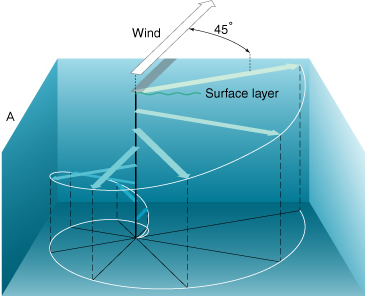
Before we get started, let’s cover some basics. One necessary concept to understand first is the Coriolis Effect which says that due to Earth’s rotation, winds and objects on the planet’s surface (most notably seen on the ocean’s surface) will deflect from their initial path. In the Northern Hemisphere, deflection is always to the right due to Earth’s counterclockwise rotation; in the Southern Hemisphere deflection is always to the left. This then ties into the workings of Ekman Transport whose source of motion comes from winds which influence wave movement. Because of the Coriolis Effect though, wave movement is always pushed from it’s original direction, resulting in an Ekman spiral. For example, if water is being pushed 90° North in the Northern Hemisphere, Coriolis will shift the water in a clockwise motion until its direction begins to shift more to the right eventually creating spiral movement.

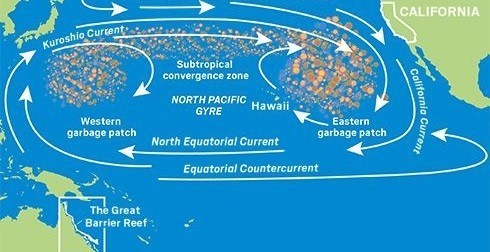
Now that we have our background information, let’s move onto currents! Currents are all over the world and are part of many important systems such as thermohaline circulation which allows for proper temperature control of the planet. Currents move with respect to the continents, forming the five main gyres: North Pacific Gyre, South Pacific Gyre, North Atlantic Gyre, South Atlantic Gyre, and Indian Ocean Gyre. A gyre is a large area whose water movement is created by the circulation of ocean currents. Now for the Great Pacific Garbage Patch, the key gyre involved is the North Pacific Garbage Patch and it’s notable currents: the California Current, North Equatorial Current, Kuroshio Current, and the North Pacific Drift. These four currents play major roles in transporting garbage from coast to coast until it all collects within the North Pacific Gyre in two ginormous groupings spread out over the width of the Pacific Ocean but are three times bigger than the entirety of France!

So now, how did this garbage patch come to be? Simple: ocean currents. Let’s look at a plastic bottle for our example. If there is a plastic bottle thrown off the West Coast of the United States, it will follow the California Current South past the coast of Mexico until both the Coriolis Effect and Ekman Transport work their ocean magic and direct the current to the right toward the open ocean. This plastic bottle will then float along the North Equatorial Current until it is caught up by smaller waves and trapped in either the Eastern Patch (closer to North America) or continues on until it reaches the Western Patch (closer to Asia). If this plastic bottle somehow misses the first turn off, it will continue until it is caught up in the Kuroshio Current along Japan where it most likely will then turn off into the other patch. If this plastic bottle somehow misses this one as well it will join the North Pacific Drift, the connecting current between the two patches which is littered with millions upon millions of discarded waste. The scariest part too is that this is not just an anomaly caused by mass waste by North America and Western Asian countries. There are major garbage patches in all five gyres which have collected trash from all surrounding countries.

This is why we must all be mindful of our plastic waste by thinking of where it ends up: killing marine life already at risk of over-fishing and other dangers such as oil spills (and other harmful chemicals), ocean acidification, and rising ocean climate. The last thing our beautiful marine life need to worry about is our mindless waste.

Design a site like this with WordPress.com
Get started